Best Blenders (2026)
Personal, countertop, and immersion blenders reviewed for motor power, noise, and versatility.
6 products tested and compared
How to Choose a Blender: A Complete Buying Guide
Blenders are one of those appliances that look straightforward until you're standing in front of thirty models wondering why they range from £35 to £600 and whether any of those differences actually matter. The short answer is: sometimes yes, often no, and it entirely depends on what you intend to blend.
This guide focuses on the realistic domestic market — personal blenders, standard countertop blenders, and immersion (stick) blenders — and gives you the practical framework to choose correctly without overpaying.
What to Look For
Wattage: How Much Power Do You Actually Need?
Wattage is the first specification most people look at and arguably one of the least useful in isolation. A higher-wattage motor can produce more torque, which matters when blending tough ingredients — frozen fruit, raw vegetables, ice, fibrous greens, nuts — but wattage alone doesn't tell you how efficiently that power is transferred through the blade assembly.
As a practical guide:
- 300–500W: Adequate for soft blending tasks — ripe fruit smoothies, soups (already cooked), sauces. Will struggle with ice and frozen fruit.
- 600–800W: The mainstream range. Handles everyday smoothies including some frozen fruit, soft vegetables, and light nut blending. A competent all-rounder.
- 900–1,200W: Handles harder tasks — leafy greens, whole nuts, ice crushing, dense root vegetables. This is where consistent results become more reliable.
- 1,200W and above: High-performance territory. Genuinely useful only if you're regularly processing very tough ingredients or making large batches.
For most people making daily smoothies with fresh fruit, yoghurt, and perhaps some spinach, 600–700W is entirely sufficient. The marketing for high-wattage blenders tends to be aspirational rather than reflective of typical use.
Blade Design
Blades vary more than most buyers realise, and the design matters as much as the motor wattage:
Blade count and angle: More blades don't automatically mean better blending. A two- or four-blade assembly with well-engineered angles can outperform a six-blade assembly with poor geometry. Look at independent tests rather than trusting blade count as a quality signal.
Blade material: Most domestic blenders use stainless steel blades. The grade of steel and precision of manufacture affect longevity. Very cheap blenders often use thinner blades that dull quickly and create contact issues with harder ingredients.
Blade-to-jug coupling: How the blade assembly connects to the jug affects both performance and longevity. Some blenders have the blade permanently attached to the jug base (cleaner seal, often dishwasher safe as a unit), while others have removable blades (easier to clean individually, but seal integrity can degrade over time).
Jug Material: Glass vs Plastic
Glass jugs are heavier, scratch-resistant, don't absorb odours or stains from ingredients like turmeric or berries, and feel more premium. They're also more fragile and significantly heavier to handle, which matters if you're pouring hot liquids.
BPA-free Tritan plastic jugs are the modern standard. Lighter, impact-resistant, and if they're made from quality Tritan (not generic plastic), they're genuinely odour- and stain-resistant. Look for explicit BPA-free certification.
Avoid older or unbranded plastic jugs that don't specify BPA-free status. Cheap polycarbonate plastic can leach BPA, particularly when blending hot liquids.
For hot soups: if you plan to blend hot liquids, be aware that standard blenders are not designed for high-temperature contents — steam pressure can cause dangerous eruptions. Some models include a vented lid cap for this reason. An immersion blender blending directly in the saucepan is often the safer and more practical solution for hot liquids.
Capacity
Standard countertop blenders typically come in 1.5–2 litre jug sizes. This is sufficient for 2–4 servings of most blended foods.
Personal blenders (where you blend directly into a single-serve cup) are typically 600–900ml. These are excellent for single-serving smoothies and are faster to clean, but they're limited — you can't blend a batch of soup or a large quantity of anything.
Consider your typical use:
- Single person making one smoothie: personal blender is ideal
- Household of two or more: standard countertop model
- Batch cooking (soups, sauces): a larger 2-litre jug is useful, or an immersion blender in the pot
Personal vs Full-Size vs Immersion
Personal blenders (also called bullet-style blenders): Compact, fast to use and clean, perfect for single-serving smoothies. The blade and motor unit screws onto a cup that doubles as your drinking vessel. Excellent for commuters or minimal kitchen setups. Weakness: limited capacity, motor longevity can be inferior to full-size models under heavy use.
Countertop blenders: The traditional form factor. More powerful motor options, larger capacity, better for batch preparation and tougher ingredients. Takes up more worktop or cupboard space.
Immersion/stick blenders: A hand-held blending wand that you submerge directly into a container. Excellent for soups, sauces, and batters where you want to blend in the vessel you're already using. Much easier to clean than a countertop jug blender. Lower motor power but often sufficient for the tasks they're best suited to. Poor for smoothies and anything requiring ice or frozen ingredients.
Many kitchens benefit from both a countertop blender and an immersion blender — they serve genuinely different purposes.
Common Mistakes to Avoid
Overpaying for Wattage You Don't Need
High-wattage motors are primarily relevant for specific use cases: crushing ice, blending whole nuts, processing very fibrous greens. If your blending diet is primarily smoothies with fresh (not frozen) fruit, yoghurt, and soft greens, a 600W blender will produce identical results to a 1,500W blender.
Be honest about what you'll blend regularly versus what you imagine blending. The aspirational use case ("I'll make nut butters and raw vegetable soups") rarely matches actual use ("I make the same three smoothies every morning").
Ignoring Jug Material
Cheap plastic jugs cloud, scratch, and absorb odours over time. A blender that smells faintly of last week's smoothie every time you open the lid is genuinely unpleasant. If you're going to use a blender daily, the jug material is worth paying attention to.
Glass is premium and durable. Quality Tritan plastic is nearly as good. Generic cheap plastic degrades noticeably within months of daily use.
Not Considering the Cleaning Reality
Blenders require cleaning after every use. The ease of cleaning should weigh heavily in your decision:
- Is the blade assembly dishwasher safe?
- Can the jug be cleaned with a simple self-clean cycle (blend water and washing-up liquid)?
- Are there narrow corners or crevices under the blade that trap residue?
A personal blender that rinses clean in seconds beats a high-spec countertop model that requires careful disassembly if the former suits your actual usage.
Price Tiers
Budget: Under £60
At this price point, you're looking at entry-level countertop blenders or well-specified personal blenders. Motor quality and blade construction are the main areas where corners are cut.
Budget countertop blenders handle soft blending tasks — fresh fruit, yoghurt, cooked soups — without issue. They struggle with ice, frozen fruit, and anything requiring sustained high-torque operation. They also tend to be louder than mid-range models.
Budget personal blenders offer excellent value for single-serve smoothies from fresh ingredients. For this specific use case, spending more doesn't necessarily produce better results.
Mid-Range: £60–£100
This is where most household needs are well served. Mid-range countertop blenders offer:
- Sufficient motor power (700–900W) for most everyday blending including frozen fruit
- Better build quality and more durable blade assemblies
- Quieter operation than budget models
- Better jug materials and sealing
- More robust warranty coverage
For two-person households that use a blender for daily smoothies, occasional soups, and standard cooking tasks, the mid-range is the optimal price point.
Premium: £100 and Above
Premium blenders justify their price for two types of buyers:
Frequent, demanding use: If you blend daily and regularly process frozen fruit, nuts, leafy greens, or make raw nut butters, a premium motor with professional-grade blade assembly will produce better results and last longer.
Noise-sensitive environments: Premium blenders often include sound enclosures that dramatically reduce operating noise — genuinely important if you're blending early in the morning in a house with sleeping people.
Beyond this, the marginal returns on spending above £150 diminish rapidly for typical domestic use. The difference between a £120 and a £300 blender is largely relevant to professional or heavy-use contexts.
Specific Advice: Matching the Blender to Your Household
Smoothies Only, or Cooking Too?
Smoothies only: A personal blender is often the best choice — fast, minimal cleanup, compact. If making smoothies for two people simultaneously, consider a mid-range countertop model with a large jug instead.
Smoothies plus soups and sauces: A countertop model is more versatile. Consider whether you'd also benefit from an immersion blender for hot liquids — the combination of a mid-range countertop blender and a budget immersion blender often outperforms a single expensive blender.
Batch cooking: Prioritise a large jug (1.75–2 litres) and consistent motor performance at sustained speeds. Look for models with a pulse function and multiple speed settings rather than just high/low.
How Many Servings at Once?
This question cuts through a lot of specification noise:
- One serving daily: Personal blender. Don't overcomplicate it.
- Two servings simultaneously: A 1.5-litre countertop blender handles this comfortably.
- Family of four or batch prep: 2-litre jug, mid-to-premium motor for consistency, consider a model with a tamper for thick blends.
Final Thoughts
The best blender is not the most powerful one — it's the one that's correctly sized for your needs, easy enough to clean that you'll actually use it daily, and built to last beyond its warranty period.
If you make one smoothie each morning, a good personal blender under £60 will serve you extremely well. If you cook for a family and use a blender across multiple tasks, invest in a mid-range countertop model and a separate immersion blender for hot soups. Only reach for premium specifications if your blending is genuinely demanding — frozen ingredients daily, nut butters, or very large batches.
Clean after every use, never blend boiling liquids in a sealed jug, and resist the urge to pay for horsepower you don't need.

Ninja
Ninja 3-in-1 Food Processor & Blender BN800UK
The Ninja BN800UK delivers genuine 3-in-1 functionality with a muscular 1200W motor and Auto-iQ intelligence. Strong ratings and extensive versatility justify its £149.99 price, though you'll pay a premium over single-purpose rivals.
Ninja
Ninja 3-in-1 Food Processor & Blender BN800UK

Ninja
Ninja 700W Slim Blender & Smoothie Maker QB3001UKS

Ninja
Ninja Professional Blender 2.0 BR201AMZ

NutriBullet
nutribullet Blender 900 Series
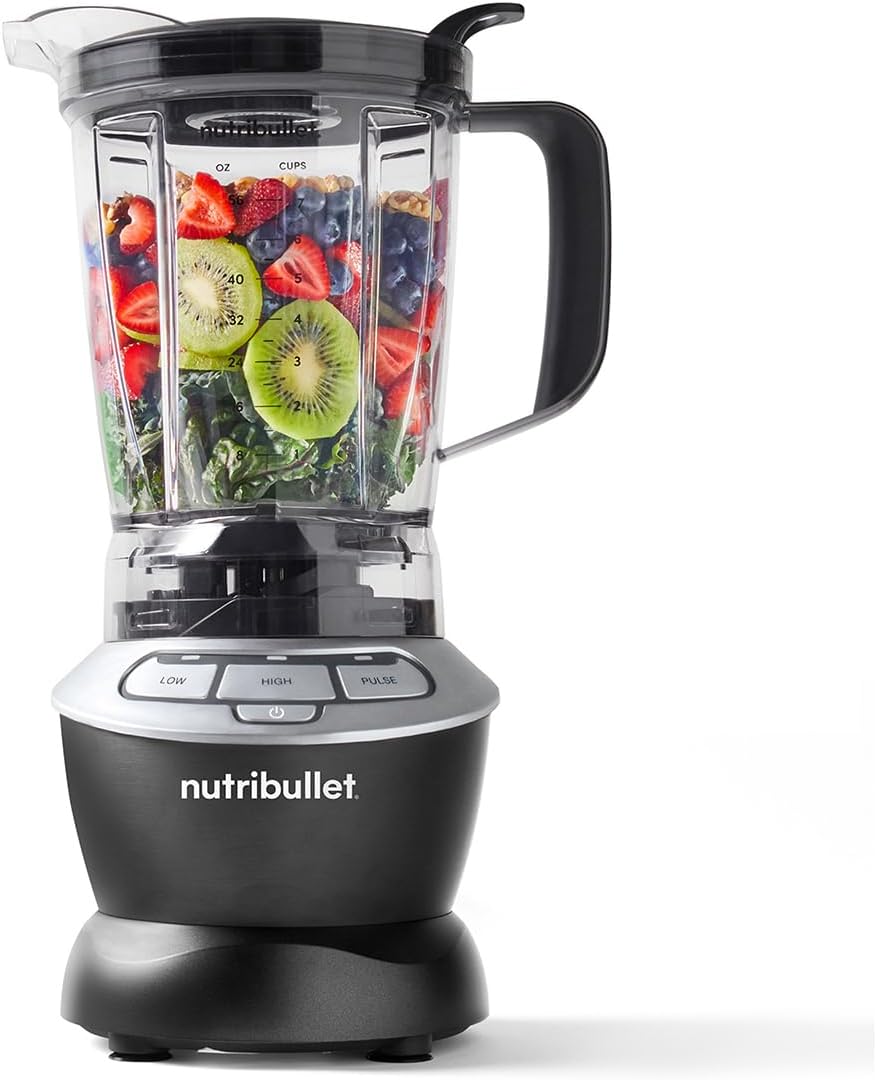
NutriBullet
nutribullet Hot and Cold Blender

NutriBullet