Best Fitness Trackers (2026)
Wristband fitness trackers and sport watches covering heart rate accuracy, battery, and coaching features.
5 products tested and compared
How to Choose a Fitness Tracker: A Complete Buying Guide
Fitness trackers have moved well beyond simple step counters. Modern devices track sleep stages, measure blood oxygen, offer guided breathing exercises, map your runs, and push smartphone notifications to your wrist. The range of features — and the range of prices — is wider than ever. The challenge is not finding a device with enough features; it is finding the right device for how you actually live and train. Buying more capability than you will use is a waste of money. Buying too little and finding yourself frustrated with limitations within a month is equally poor value. This guide helps you identify what genuinely matters for your situation.
What to Look For
Optical Heart Rate Sensor Accuracy
The green light sensor on the underside of virtually every fitness tracker uses photoplethysmography (PPG) to estimate your heart rate by measuring blood flow through your wrist. It is a remarkably clever technology — and one with meaningful limitations that are frequently glossed over.
Optical heart rate sensors perform well at rest and during steady-state exercise such as walking, jogging, or cycling at a consistent pace. They struggle during high-intensity intervals, weight training, and activities involving significant wrist movement, because the sensor confuses motion artefacts for heartbeats. At these intensities, wrist-based readings can be several beats per minute off — sometimes significantly more.
For general health monitoring, sleep tracking, and zone-based cardio training at moderate intensity, optical HR sensors are good enough. For precise interval training, competitive racing, or medical monitoring, a chest strap remains considerably more accurate. Some trackers support connection to an external chest strap; if precision matters, this is worth checking.
When evaluating HR accuracy, look for independent test data from sources that measure accuracy across multiple activities and intensities, not just walking. Manufacturer claims are uniformly optimistic.
GPS: Built-In vs Connected
Built-in GPS means the tracker has its own location receiver and can map your routes independently of your phone. Connected GPS (sometimes called phone GPS or assisted GPS) means the tracker borrows the GPS signal from a paired smartphone in your pocket.
For outdoor runners, cyclists, and hikers who want accurate distance, pace, and route mapping without carrying a phone, built-in GPS is essential. It is also the primary reason fitness trackers cost significantly more beyond the budget tier — GPS hardware is expensive.
If you always carry your phone when exercising, connected GPS is a perfectly acceptable compromise and saves battery life considerably. If you want to leave your phone at home during runs or rides, built-in GPS is non-negotiable.
Note that GPS accuracy also varies between devices. Look for reviews that specifically test GPS trace accuracy against known routes rather than relying on manufacturer specifications alone.
Battery Life
Battery life is one of the most important practical considerations and one where manufacturer claims require careful scrutiny. Quoted battery life typically reflects best-case conditions: full charge, no GPS, minimal notifications, screen set to dim. Real-world battery life with always-on display, regular GPS use, and continuous heart rate monitoring is typically 30–50% lower.
For a basic tracker used for step counting and sleep monitoring, even a modest battery should last several days. For a device with always-on GPS and continuous monitoring, daily charging may be necessary at the more ambitious end.
Think about how battery life fits your life. If you travel frequently or dislike routine charging, prioritise long battery life. If you charge your devices nightly alongside your phone, a two-day battery is not the hardship it sounds.
Water Resistance: ATM Rating
ATM (atmospheres) is the standard measure of water resistance for wearables:
- 3 ATM / 30 m: Splash-proof and suitable for rain and sweat; not suitable for swimming.
- 5 ATM / 50 m: Suitable for swimming in pools and shallow water; not suitable for diving or high-impact water sports.
- 10 ATM / 100 m: Suitable for most water sports, snorkelling, and extended submersion.
Note that ATM ratings are tested under static conditions; high-impact activities like diving into water generate momentarily higher pressures. For swimmers, a minimum of 5 ATM is required. For water sports enthusiasts or those who want to shower with the device on without concern, 5 ATM is a reasonable minimum.
Display Type
Fitness trackers typically use one of three display types: AMOLED, LCD, or memory-in-pixel (MIP).
AMOLED displays are vivid and sharp, with excellent readability in most conditions and always-on capability — though always-on AMOLED significantly reduces battery life. They are the standard on mid-range and premium devices.
LCD displays are brighter in direct sunlight but drain battery faster than AMOLED. Less common on modern trackers.
MIP (memory-in-pixel) displays consume minimal power and are exceptionally readable in bright sunlight, making them popular on devices where battery life is paramount. The trade-off is a lower-resolution, less vivid display that looks dated compared to AMOLED in normal lighting.
If you exercise primarily outdoors in bright light, a high-brightness display or MIP panel is useful. If you mainly use the tracker indoors or at night, AMOLED is the more pleasant daily companion.
App Ecosystem
The companion app is where your data lives, and your choice of device locks you into an ecosystem. Some platforms are open — exporting data to Apple Health, Google Health Connect, or Strava is straightforward. Others are more closed, making it difficult to transfer your data if you switch devices.
Consider which platforms you already use. If you track runs on Strava or sync health data to Apple Health, check that the device you are considering integrates directly. The tracker itself may be excellent while the app experience is poor — or vice versa. App quality, including the quality of sleep analysis presentation, coaching insights, and historical data visualisation, varies enormously.
Common Mistakes
Buying a Smartwatch When You Need a Tracker
Full smartwatches — with app stores, music storage, contactless payments, and large displays — are impressive devices. They are also considerably more expensive, heavier on the wrist, and shorter on battery life than dedicated fitness trackers. If you primarily want step counting, sleep tracking, and basic heart rate monitoring, a full smartwatch is buying significantly more capability than you need. Trackers are lighter, more comfortable for sleep monitoring, and typically offer better battery life.
Ignoring Ecosystem Lock-In
Every fitness platform accumulates data over time — sleep history, resting heart rate trends, training load. When this data is locked in a proprietary platform, switching devices means starting from scratch. Before committing to a device, check how easily data can be exported and whether the platform has a track record of allowing transitions. Open platforms that integrate with Apple Health or Google Health Connect protect your historical data regardless of what device you use in future.
Trusting Calorie Burn Numbers
Calorie burn estimates from wrist-based trackers are notoriously inaccurate — studies consistently show errors of 20–40% compared to laboratory measurement. This applies to all devices, regardless of price or brand. Treat calorie data as a relative indicator of exertion rather than an accurate absolute figure. Specifically, do not use tracker calorie data to justify eating more after exercise, as the error margins are large enough to erase the deficit entirely.
Price Tiers
Budget: Under £40
At this price point, expect basic step counting, sleep tracking (typically just total sleep duration rather than sleep stage analysis), continuous heart rate monitoring of moderate accuracy, and notifications. GPS is not available at this price on wearables — a connected GPS workout mode may be offered. Battery life is often the standout feature in this tier, with some devices lasting a week or more. For users who primarily want a daily activity nudge and basic sleep awareness, budget trackers are surprisingly capable.
Mid-Range: £40–£80
This range is where fitness tracking becomes genuinely comprehensive. Expect sleep stage analysis (light, deep, REM), SpO2 (blood oxygen) monitoring, stress tracking, menstrual cycle tracking on applicable devices, and connected GPS workout modes. Some devices in this range include built-in GPS. App ecosystems are more developed, with coaching insights and trend analysis. For the majority of non-competitive exercisers, this tier represents the best value.
Premium: £80+
Premium trackers introduce built-in GPS as standard, more sophisticated training metrics (VO2 max estimation, training load, recovery time), advanced sleep coaching, ECG capability on select models, and significantly better build quality and display quality. For serious runners, cyclists, or triathletes who want detailed training analysis without paying full smartwatch prices, premium fitness trackers offer a compelling middle ground.
Specific Advice for Your Situation
Steps and Sleep Only, or Serious Training?
If your primary goals are walking more and understanding your sleep better, you do not need GPS, VO2 max, or advanced training metrics. A budget or entry-level mid-range tracker with good sleep stage analysis and a comfortable strap is all you need. Focus your evaluation on sleep tracking quality and wearability — if it is uncomfortable, you will not wear it at night, at which point the sleep tracking is worthless.
If you run, cycle, or do structured cardio training and want to improve, built-in GPS (or at minimum connected GPS) and heart rate zone tracking become valuable. Training load and recovery features, available in the premium tier, are genuinely useful for managing training volume without overreaching.
Do You Need GPS?
Only if you care about accurate pace and distance during outdoor workouts without carrying your phone. If you always run with your phone or primarily exercise indoors on equipment with its own metrics, connected GPS or no GPS is fine. GPS capability adds cost and reduces battery life; do not pay for it if you will not use it.
Phone Compatibility
Most fitness trackers are compatible with both Android and iOS, but the depth of integration varies. Some features — particularly Siri or Google Assistant integration, NFC payments, and notification handling — differ between platforms. A handful of devices are iOS-only or offer significantly reduced functionality on Android. Check compatibility with your specific phone before purchasing. If you use a less common Android manufacturer, verify that the companion app is available and well-supported on your device.
Final Thoughts
The best fitness tracker is the one you actually wear every day. Comfort, battery life, and app usability matter as much as sensor specifications. A device with impressive paper specifications that sits in a drawer because the strap is irritating or the app is confusing is worth nothing. Prioritise the features that match your actual lifestyle and exercise habits, read independent reviews that cover real-world accuracy rather than parroting specification sheets, and choose a platform with a good track record of software updates and data portability. A good fitness tracker should feel invisible on your wrist and quietly motivate better habits over time — that is its entire purpose.

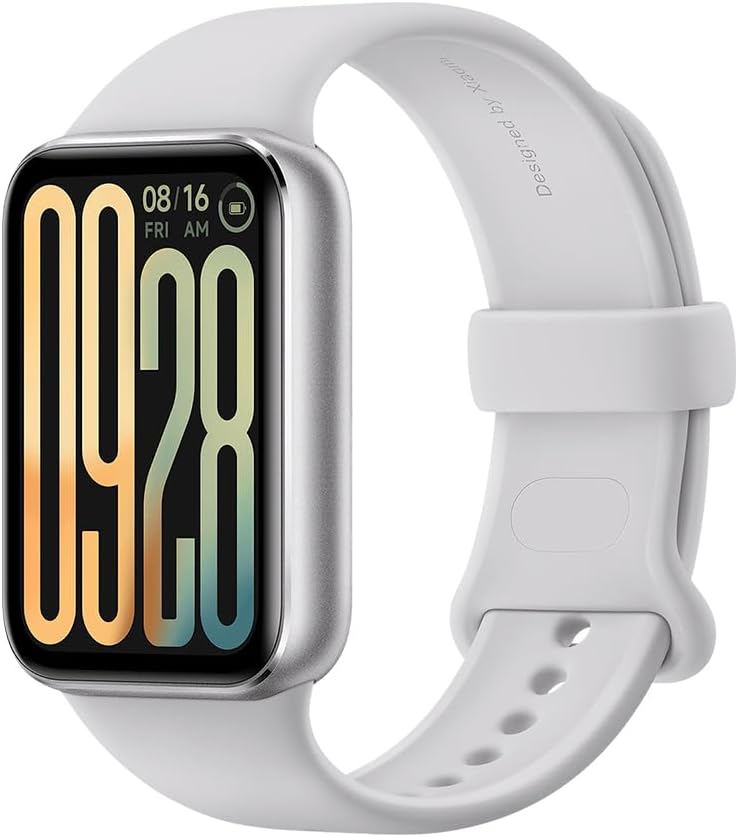
Xiaomi
Xiaomi Smart Band 9 Arctic Blue
The Xiaomi Smart Band 9 Arctic Blue delivers a vibrant AMOLED display, impressive battery life, and comprehensive workout tracking for under £40. A genuinely compelling choice for fitness-focused buyers who don't want to spend £100+ on a smartwatch.